What Is the Biggest Problem in Commercial Real Estate?
Commercial real estate faces significant challenges, with market uncertainty emerging as the most critical issue impacting demand, pricing, and leasing stability. Investors often struggle with high capital requirements, long vacancy periods, and complex regulatory processes. Owning commercial property also comes with issues like maintenance costs, tenant management, and liquidity constraints. Despite these challenges, the sector continues to offer strong opportunities in office spaces, logistics, retail, and flexible workspaces. With the right strategy and expert guidance, investors can successfully navigate risks and tap into the growing potential of the commercial real estate market.
Commercial real estate (CRE) remains one of the most attractive investment options for businesses and individual investors. With its potential for stable rental income, long-term appreciation, and portfolio diversification, the sector continues to grow rapidly, especially in dynamic markets like India.
Yet, with all its benefits, commercial real estate comes with its own set of challenges, risks, and structural problems that investors must understand before stepping in.
In this blog, we unpack the biggest problems in commercial real estate, the risks in the CRE market, the common problems of owning a commercial property, and finally, the opportunities that still make CRE a powerful investment option.
The Biggest Problem in Commercial Real Estate: Market Uncertainty
If there’s one issue that dominates commercial real estate today, it’s market uncertainty.
Why market uncertainty is such a big problem
- Demand patterns are shifting due to hybrid work, changing retail trends, and flexible leasing models.
- Interest rates and inflation continue to influence property valuations and financing costs.
- Economic slowdowns directly impact occupancy levels and rental yields.
- Global events (pandemics, geopolitical tensions) create unpredictable cycles.
Commercial real estate thrives on stability. When that stability shakes, everything from pricing to tenant retention becomes harder to manage.
Major Commercial Real Estate Challenges
- High Capital Requirement: Investing in CRE demands substantial upfront capital, making it inaccessible for many individual investors.
- Longer Vacancy Cycles: Unlike residential properties, commercial spaces can remain vacant for months or even years.
- Regulatory and Compliance Burdens: From zoning rules to environmental clearance, CRE involves complex documentation that can slow down projects.
- Tenant Reliability Issues: Corporate tenants are generally more stable, but defaulting or early exits can cause significant revenue loss.
- Asset Management Complexity: Managing maintenance, utilities, building operations, and tenant expectations requires expertise and consistent cash flow.
Risks in the Commercial Real Estate Market
CRE carries both predictable and unpredictable risks. The major ones include:
- Financial Risk: Rising interest rates and borrowing costs make financing more expensive, reducing profitability.
- Market Risk: Prices fluctuate based on supply-demand imbalance, economic performance, and investor sentiment.
- Leasing Risk: If your property stays vacant, the EMI doesn’t stop, but your income does.
- Legal and Regulatory Risk: Non-compliance with RERA, fire norms, FSI limits, and safety standards can lead to penalties or delays.
- Location Risk: A poor location drastically reduces rental yields and resale value.
Despite the risks and challenges, the long-term potential makes CRE attractive, here are the Top 10 Reasons to Invest in Commercial Property.
Problems of Owning a Commercial Property
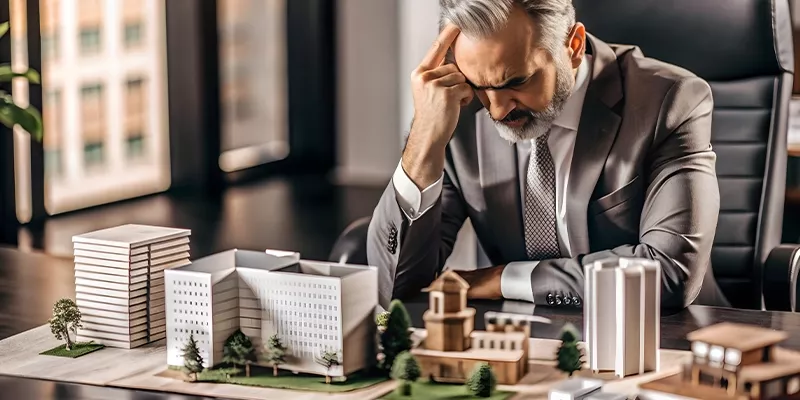
Even after purchase, ownership comes with challenges like:
- High Maintenance Costs: Commercial buildings require regular upkeep, elevators, HVAC, lobbies, parking, power backup, security, etc.
- Difficulty Finding Long-Term Tenants: Industries evolve quickly, making long-term leasing less predictable.
- Limited Liquidity: Selling a commercial property is far more difficult compared to a residential unit.
- Rental Income Fluctuations: Income depends heavily on economic cycles and tenant renewal terms.
- Depreciation & Upgrades: To stay competitive, periodic upgrades in design, tech, safety, and sustainability are essential.
Opportunities in the Commercial Real Estate Market
Despite its challenges, CRE today offers strong and emerging opportunities, especially in India:
- Growth of Grade-A Office Spaces: Demand from IT, GCCs, start-ups, and global enterprises continues to push office absorption.
- Rise of Warehousing & Logistics: E-commerce, 3PL players, and supply-chain expansion have created huge demand for industrial spaces.
- Flexible Workspace Boom: Co-working and hybrid spaces offer investors new models with stable occupancy.
- Retail Evolution: Malls with experiential elements, F&B clusters, and high-street retail continue to perform well.
- REITs for Small Investors: Real Estate Investment Trusts democratize commercial real estate, allowing investors to start small.
To understand how to build a strong commercial portfolio, read: Commercial Property Investment Guide.
Conclusion
Commercial real estate remains a high-reward, high-complexity sector. While market uncertainty stands out as the biggest challenge, investors who understand the risks, operational demands, and evolving opportunities can still build strong long-term wealth through CRE. Partnering with expert consultants like Address Advisors can further simplify decision-making, provide market-backed insights, and help investors identify the right assets with confidence. With the right guidance and strategy, commercial real estate continues to be one of the most powerful avenues for sustainable growth.
Frequently Asked Questions
Market uncertainty; including shifting demand and economic volatility is the biggest challenge affecting valuations, leasing, and long-term planning.
High capital costs, long vacancies, tenant management, regulatory hurdles, and operational complexity are major CRE challenges.
Key risks include financial risk, leasing risk, market fluctuations, compliance issues, and location-dependent performance.
Owners often deal with maintenance expenses, revenue fluctuations, difficulty selling, and the need for continuous upgrades.
Yes. Growth in office spaces, warehousing, co-working, high-street retail, and REITs present strong opportunities for investors.