What Is a RERA Carpet Area? Meaning & Calculation Guide

Summary
RERA carpet area is the net usable floor area of an apartment, excluding external walls, service shafts, exclusive balconies or verandahs, and open terraces, while including internal partition walls. It gives homebuyers a clear and standardized measure of the actual internal space they are purchasing under the Real Estate (Regulation and Development) Act, 2016.
Property listings often throw around terms like carpet area, built-up area, and super built-up area, sometimes interchangeably, which is exactly the problem. Before the Real Estate (Regulation and Development) Act, 2016, there was no single legal definition of these terms, so a "1,200 sq. ft. apartment" from one developer could mean something very different from another's. The introduction of the Real Estate Regulatory Authority (RERA) brought greater standardization by giving carpet area a precise and legally enforceable meaning. Here's what it is, how to calculate it, and how to make sure the number on paper matches what you're actually getting.
What Is RERA Carpet Area?
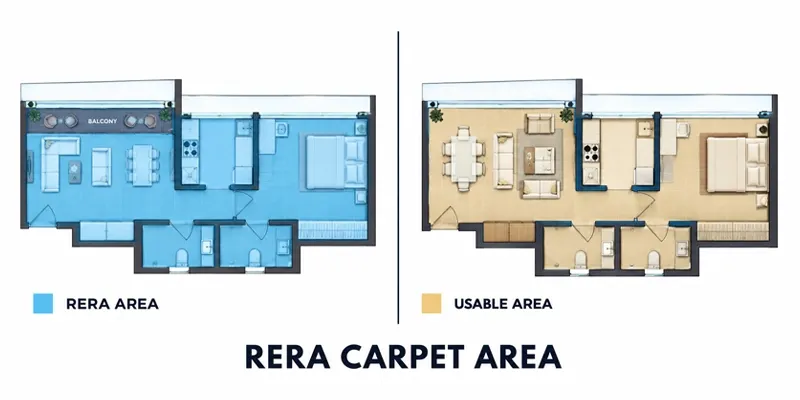
So, what is the RERA carpet area? In simple terms, the RERA carpet area meaning comes down to the net usable floor area of an apartment - the space you can actually walk on and furnish inside your own four walls.
The official RERA carpet area definition, as laid out under the RERA Act, gives this measurement a precise, legally enforceable meaning rather than leaving it open to a developer's interpretation.
Under the RERA Act, it:
- Includes the area taken up by internal partition walls (the walls dividing your bedroom from your living room, for instance)
- Excludes external walls, service shafts (like plumbing or electrical ducts), exclusive balconies or verandahs, and exclusive open terraces
In short, it's the most conservative - and most honest - measure of how much space you're paying for.
How It Compares to Built-Up Area and Super Built-Up Area
These three terms describe increasingly larger areas, and each one adds something carpet area doesn't count:
|
Term |
What it includes |
|
Carpet Area |
Net usable space + internal partition walls |
|
Built-Up Area |
Carpet area + external walls + balconies/terraces |
|
Super Built-Up Area |
Built-up area + a share of common spaces (lobbies, staircases, corridors) |
A term you'll sometimes see in brochures - "usable area" - isn't legally standardized the way carpet area is, so treat it as a loose descriptor rather than something to rely on.
Because a super built-up area folds in shared spaces you don't exclusively own, it's always larger than the carpet area for the same unit - sometimes by 20–30%. This is why comparing two apartments by a super built-up area alone can be misleading.
For a clearer comparison, read our guide on Understanding Carpet Area, Built-up Area, and Super Built-up Area
How to Calculate RERA Carpet Area
Once you know the definition, the next question is naturally how to calculate RERA carpet area for a specific apartment. The formula is straightforward:
RERA Carpet Area = Net Usable Floor Area + Internal Partition Wall Area
And separately, these are excluded from the number:
External Walls + Service Shafts + Exclusive Balconies/Verandahs + Exclusive Open Terraces
Example: An apartment has 900 sq. ft. of usable internal floor space and 60 sq. ft. taken up by internal partition walls.
RERA Carpet Area = 900 + 60 = 960 sq. ft.
Any balcony, external wall, or service shaft area sits outside this figure entirely.
Don't take a developer's word for this number - cross-check it against the approved building plans, the agreement for sale, and the project's RERA filing.
Why RERA Carpet Area Affects Price and Value
Carpet area is the fairest basis for comparing what you're actually paying for:
- Price per sq. ft.: Calculating cost based on carpet area (rather than super built-up area) tells you the real price of the usable space - and this is now mandatory for developers to disclose under RERA.
- Space efficiency: Two apartments with the same super built-up area can have noticeably different carpet areas depending on how much space the building's common areas eat up. The one with more carpet area for the same price is the better deal.
- Getting it wrong costs you: If the actual carpet area turns out smaller than what was promised, you've effectively paid for space that doesn't exist. RERA gives buyers the right to a refund or compensation in such cases, which is one reason accurate disclosure matters legally, not just practically.
How to Verify RERA Carpet Area Before You Buy
Before signing anything, run through this checklist:
- Read the agreement for sale carefully. It must state the carpet area explicitly.
- Check it against the floor plan. Measurements should match the approved layout and dimensions.
- Look up the project on your state's RERA portal. Developers are required to file accurate carpet area details there.
- Cross-check every document. The brochure, cost sheet, and agreement should all quote the same figure - inconsistencies are a red flag.
- Compare properties by carpet area, not super built-up area. It's the only apples-to-apples way to judge which unit gives you more usable space for your money.
Before finalising the purchase, buyers should also review the documents to check before buying a flat from a builder to verify ownership, approvals, project registration, and other legal details.
CONCLUSION
Understanding what is RERA carpet area helps homebuyers know how much usable internal space they are actually getting. Since RERA provides a standardized definition, buyers can compare projects more accurately and understand the relationship between property size and price. Before purchasing a home, always verify the carpet area mentioned in the agreement, approved plans and RERA project records.
 Address Advisors
Discover all our blogs covering real estate insights, market trends, workspace strategies, and industry updates. Explore expert perspectives and valuable information designed to help you make informed property decisions.
Frequently Asked Questions
The definition is uniform under the central RERA Act, but always confirm details through your specific state's RERA authority, since implementation and enforcement can vary.
No. Exclusive balconies, verandahs, and open terraces are excluded from RERA carpet area, even though they may be included in built-up or super built-up areas.
Under RERA, developers generally cannot alter the carpet area beyond a small permissible variation (typically up to 3%) without informing and compensating the buyer.
Developers can still market a project using a super built-up area, but under RERA they are legally required to also disclose the carpet area, and pricing disclosures must be tied to it - which is why understanding the RERA carpet area definition matters even if it isn't the headline number in an ad.