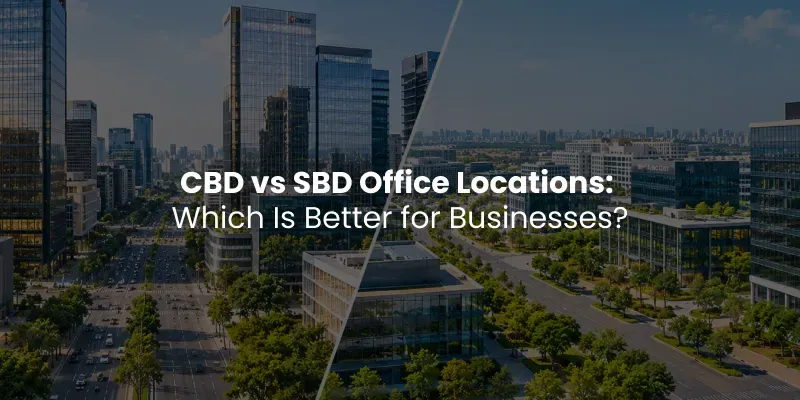
CBD vs SBD Office Locations: Which Is Better for Businesses?
Summary
CBD is better for businesses prioritising corporate prestige, established networks, and client accessibility, while SBD is suitable for companies seeking modern office infrastructure, larger workspaces, and expansion flexibility. The right choice depends on rental costs, employee accessibility, connectivity, and operational requirements. Businesses should evaluate these factors to select an office location that supports long-term growth and commercial success.
A Central Business District (CBD) represents the traditional commercial centre of a city, while a Secondary Business District (SBD) is an established or emerging commercial hub outside the city centre. Both offer distinct advantages for companies looking for commercial office space, but their suitability depends on business requirements, operational priorities, and investment objectives.
With the expansion of India's commercial real estate market, SBD locations are increasingly attracting IT companies, multinational corporations, Global Capability Centres (GCCs), and growing businesses. Meanwhile, CBD office locations continue to appeal to organisations that prioritise corporate visibility, established business networks, and proximity to financial institutions.
Understanding the difference between CBD and SBD office locations can help businesses make informed commercial property and office leasing decisions.
What Is a Central Business District (CBD)?
A Central Business District (CBD) is the primary commercial and financial centre of a city. It typically accommodates corporate headquarters, financial institutions, consulting firms, legal practices, premium commercial establishments, and other professional services.
CBD office locations generally benefit from established infrastructure, strong business connectivity, and proximity to important commercial institutions.
Key Features of CBD Office Locations:
- Prime commercial location: CBDs are situated within established business centres, offering access to major commercial establishments.
- Business networking opportunities: Companies benefit from proximity to financial institutions, corporate offices, government establishments, and professional service providers.
- Corporate visibility: A prestigious CBD business address can support brand positioning and corporate reputation.
- Established infrastructure: Central business districts generally have developed road networks, public transportation, hotels, restaurants, and other business facilities.
- Client accessibility: Businesses with frequent client interactions can benefit from being located near established commercial networks.
Examples of CBD Locations in India
Some prominent CBD office locations in India include:
- Mumbai: Nariman Point, Fort, and Ballard Estate.
- Bengaluru: MG Road and Residency Road.
- Delhi: Connaught Place.
- Chennai: Anna Salai and surrounding central commercial areas.
For example, businesses exploring established commercial hubs can understand the advantages of renting office space in Bangalore's CBD
These locations are particularly relevant for financial services, consulting firms, legal practices, and businesses that depend on established corporate relationships.
What Is a Secondary Business District (SBD)?
A Secondary Business District (SBD) is a commercial business hub located outside a city's traditional central business area. These districts develop as urban expansion, infrastructure investment, residential development, and corporate demand create new commercial centres.
SBD office locations frequently accommodate modern office parks, Grade A commercial buildings, IT campuses, multinational corporations, and Global Capability Centres.
SBDs are also closely associated with the development of peripheral business districts, where expanding commercial activity creates new employment and business centres beyond traditional city centres.
Key Features of SBD Office Locations
- Modern commercial infrastructure: SBDs often feature contemporary office buildings with advanced facilities and building management systems.
- Competitive office leasing options: Businesses may find a wider range of commercial office space and leasing opportunities.
- Larger office spaces: Newer commercial developments can offer larger floor plates and opportunities for expansion.
- Employee accessibility: Proximity to growing residential areas can improve access to the workforce.
- Emerging business ecosystems: SBD locations increasingly attract technology companies, startups, corporate offices, and supporting commercial establishments.
Examples of SBD Locations in India
Some prominent secondary business districts include:
- Bengaluru: Whitefield, Outer Ring Road, and parts of Electronic City.
- Mumbai: Powai and Andheri East.
- Hyderabad: HITEC City and Gachibowli.
- Pune: Hinjawadi and Kharadi.
- Delhi NCR: Gurugram and Noida.
These locations have become important commercial destinations for IT companies, multinational corporations, business process outsourcing companies, and large corporate occupiers.
CBD vs SBD Office Locations: Key Differences
When comparing CBD vs SBD office space, businesses should evaluate more than geographical location. Factors such as commercial infrastructure, office rental costs, employee accessibility, property availability, and expansion opportunities can influence the overall value of a commercial property.
|
Evaluation Parameter |
CBD |
SBD |
|
Commercial Positioning |
Established city centre |
Secondary commercial hub |
|
Business Ecosystem |
Mature and concentrated |
Developing or established |
|
Office Building Profile |
Mix of older and premium buildings |
Often newer commercial developments |
|
Rental Structure |
Location and building dependent; often premium |
Competitive in some markets |
|
Large Contiguous Spaces |
Can be limited |
Often more available |
|
Parking Facilities |
May be constrained |
Often better provisioned |
|
Employee Accessibility |
Strong central connectivity |
Depends on residential catchments |
|
Client Interaction |
Convenient for central business networks |
Convenient for businesses with suburban clients |
|
Expansion Flexibility |
May be constrained by property availability |
Often greater choice |
|
Corporate Identity |
Traditional commercial prestige |
Modern corporate positioning |
The key difference between CBD and SBD is not simply their location or rental value. It is how effectively each business district supports a company's operational and commercial requirements.
CBD vs SBD: Understanding Office Rental Costs
Office rental costs are among the most important factors when selecting commercial office space. However, businesses should compare the total cost of occupancy rather than focusing exclusively on the quoted rental rate.
CBD office space may command premium rentals because of its established commercial location, while SBD office space may offer competitive leasing opportunities depending on the building, location, and market demand.
A lower rental rate does not automatically guarantee better commercial value. Businesses should assess the overall occupancy cost before finalising an office lease.
Employee Accessibility and Connectivity: CBD vs SBD
Employee accessibility is an important consideration when comparing CBD and SBD office locations.
Traditional CBDs generally benefit from established transportation networks and central connectivity. However, employees travelling from distant residential areas may experience longer commuting times during peak hours.
SBD locations can provide advantages when they are situated near growing residential catchments and employment corridors. This can improve workforce accessibility and make office commuting more convenient.
For example:
- Bengaluru's Outer Ring Road is an important corporate and technology employment corridor. Whitefield benefits from a growing residential and commercial ecosystem.
- Hyderabad's HITEC City and Gachibowli accommodate major corporate employment clusters.
- Mumbai's Powai and Andheri East offer access to established residential and commercial areas.
Businesses should evaluate metro connectivity, public transportation, road congestion, airport access, and employee residential distribution when selecting commercial office space.
Which Businesses Should Choose CBD or SBD Office Locations?
The right commercial office location depends on the nature of business operations, workforce size, client requirements, and expansion strategy.
|
Business Category |
Preferred Location |
Reason |
|
Banking and Financial Services |
CBD |
Proximity to financial institutions and established business networks |
|
Legal and Consulting Firms |
CBD |
Client accessibility and corporate positioning |
|
IT and Technology Companies |
SBD |
Larger office campuses and modern infrastructure |
|
Global Capability Centres |
SBD |
Space availability and operational scalability |
|
Business Process Outsourcing |
SBD |
Large workforce and office space requirements |
|
Startups |
CBD or SBD |
Depends on budget, talent, and client requirements |
|
Corporate Headquarters |
CBD or SBD |
Depends on corporate strategy |
|
Research and Development |
SBD |
Potential access to larger commercial facilities |
For businesses with frequent client-facing operations, CBD locations can offer strategic advantages. For organisations requiring large office spaces, employee capacity, and expansion flexibility, SBD locations can be attractive alternatives.
Factors to Consider Before Choosing CBD or SBD Office Space
Before finalising a commercial property, businesses should conduct a detailed office location assessment.
1. Total Occupancy Cost
Compare base rent, CAM charges, utilities, deposits, fit-out costs, parking, and lease escalation clauses.
2. Employee Accessibility
Evaluate employee residential locations, peak-hour commuting times, public transportation, and workforce availability.
3. Client and Business Connectivity
Consider proximity to important clients, suppliers, financial institutions, business partners, and commercial establishments.
4. Building Quality and Infrastructure
Assess building specifications, safety compliance, power backup, internet connectivity, and facility management.
5. Office Expansion Opportunities
Determine whether the property can accommodate future workforce growth, additional floors, or adjoining office spaces.
6. Transportation Infrastructure
Evaluate metro connectivity, road access, airport proximity, and public transportation facilities.
7. Lease Flexibility
Review lease tenure, lock-in periods, renewal conditions, rent escalation, and termination clauses.
8. Long-Term Commercial Viability
Consider future infrastructure development, commercial demand, surrounding residential growth, and the business district's long-term potential.
Understanding how to negotiate commercial lease terms can also help businesses evaluate rental escalations, lock-in periods, renewal conditions, and other contractual obligations.
CBD vs SBD Office Locations: Which Is Better for Businesses?

There is no universally better option when comparing CBD vs SBD office locations. Both commercial districts serve different business requirements.
CBD office locations are suitable for organisations that prioritise established commercial networks, client accessibility, financial institutions, and corporate visibility.
SBD office locations are attractive for businesses seeking modern commercial infrastructure, larger office spaces, competitive leasing opportunities, and expansion flexibility.
For companies planning to lease or relocate commercial office space, the decision should be based on total occupancy costs, employee accessibility, building quality, business connectivity, and long-term operational requirements.
Ultimately, the best office location is one that aligns with the company's business model, financial objectives, workforce requirements, and future expansion strategy.
Conclusion
Choosing between CBD and SBD office locations depends on a business's operational needs, budget, and long-term growth objectives. While CBD offers established business networks, corporate visibility, and central connectivity, SBD provides modern office infrastructure, larger workspaces, and greater expansion flexibility.
Ultimately, businesses should evaluate rental costs, employee accessibility, building quality, and connectivity before selecting an office location. The right commercial office space can improve operational efficiency, support workforce productivity, and create opportunities for sustainable business growth.
 Address Advisors
Discover all our blogs covering real estate insights, market trends, workspace strategies, and industry updates. Explore expert perspectives and valuable information designed to help you make informed property decisions.
Frequently Asked Questions
CBD refers to the traditional central commercial area of a city, while SBD refers to an established or emerging commercial business district outside the traditional city centre.
CBD office space often commands premium rentals due to its established commercial positioning. However, rental costs depend on property specifications, building quality, market demand, and connectivity.
Companies are increasingly considering SBD office locations because of modern office infrastructure, larger commercial developments, employee catchments, and opportunities for business expansion.
Yes. Established SBD markets accommodate multinational corporations, IT companies, Global Capability Centres, and other large corporate occupiers.
CBD may be better for businesses prioritising central connectivity and corporate visibility, while SBD may be suitable for businesses seeking larger office spaces and operational flexibility. The final decision depends on business requirements and total occupancy costs.