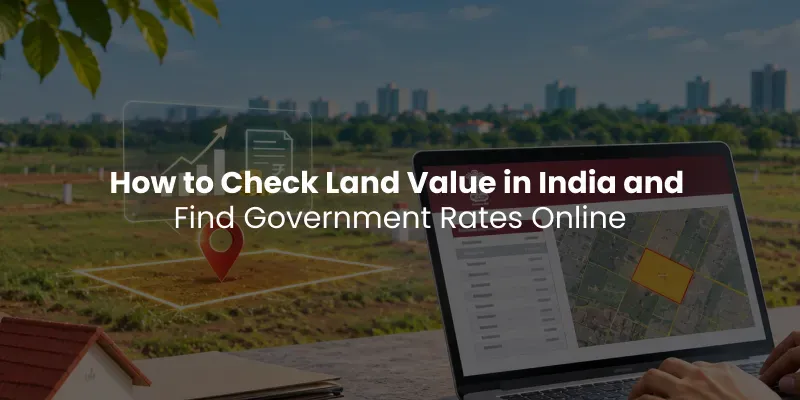
How to Check Land Value in India and Find Government Rates Online
Summary
You can check the government value of land in India online by visiting your state's official registration and stamps department website or the NGDRS property valuation portal. Select your state, district, village or locality, enter the required land details and choose the applicable land category to view the government-prescribed rate. Multiply this rate by your total land area to estimate the government's valuation of your property.
Buying or selling land is an important financial decision. Before making any property transaction, it is essential to understand the actual value of the land. Many buyers and sellers want to know how much their land is worth and what price the government has fixed for that particular location.
Today, you do not need to visit government offices to find this information. You can use online government portals to check land prices, guideline values and registration rates.
If you are wondering how to check land value in India, this guide explains everything you need to know. You will learn how to find government land rates online, understand circle rates, check state-wise land values and estimate your property's value using simple steps.
What Is Government Land Value?
Government land value is the minimum property value determined by the respective state government for a particular location. It is generally used to calculate stamp duty and registration charges during property transactions.
This value is known by different names in different Indian states, such as:
- Guidance Value: Karnataka
- Circle Rate: Delhi and Uttar Pradesh
- Ready Reckoner Rate: Maharashtra
- Guideline Value: Tamil Nadu
- Jantri Rate: Gujarat
- Fair Value: Kerala
- DLC Rate: Rajasthan
These rates may vary depending on the location, land type, road access, property usage and other factors.
Understanding government land value helps buyers and sellers make informed decisions before purchasing or selling property.
How to Check Land Value Online in India?
Checking land value online is simple when you have the correct property details. Most state governments provide online registration and property valuation services.
Follow these steps to find the government value of your land:
Step 1: Visit the Official Government Portal
First, visit the official registration and stamps department website of your state. These portals provide information about government property rates and valuation services.
You can also visit the National Generic Document Registration System (NGDRS) website to find property valuation rates published by participating states.
Step 2: Select Your State and District
After opening the valuation portal, select your state and district.
Depending on the portal, you may also need to choose your taluk, tehsil, village, municipal area or local governing body.
Make sure you select the correct location because government land rates can differ even between nearby areas.
Step 3: Enter Your Land Details
Provide the required property information, such as:
- Village or locality name
- Survey number or property identification details, if requested
- Land type
- Property usage
- Total land area
- Registration or valuation zone
The information required may differ depending on your state's website.
Step 4: View the Government Land Rate
Once you enter the required details, the portal may display the applicable government rate for your selected location.
The rate may be displayed per square foot, square metre, acre or other measurement unit.
Check the applicable financial year and rate category before using the information.
Step 5: Calculate the Estimated Land Value
After finding the government rate, multiply it by the total land area to estimate the property's government valuation.
For example:
If the government rate is ₹2,000 per square foot and your land area is 1,200 square feet:
Estimated Government Land Value = 1,200 × ₹2,000
Total Value = ₹24,00,000 (₹24 lakh)
This is a simple example. Actual valuation may involve additional rules, location-based factors and property classifications.
How to Know Government Value of Land in Different States?
Every state has its own registration department and property valuation system. Therefore, the process of checking government land rates may differ from one state to another.
Here are some popular state-wise government portals:
|
State |
Government Rate Name |
Official Website |
|
Karnataka |
Guidance Value |
|
|
Maharashtra |
Ready Reckoner Rate |
|
|
Tamil Nadu |
Guideline Value |
|
|
Gujarat |
Jantri Rate |
|
|
Kerala |
Fair Value |
|
|
Delhi |
Circle Rate |
|
|
Uttar Pradesh |
Circle Rate |
|
|
Rajasthan |
DLC Rate |
|
|
Telangana |
Market Value |
|
|
Andhra Pradesh |
Market Value |
You can visit the respective state portal and search for the applicable land valuation service.
In Karnataka, the government-prescribed guidance value serves as a benchmark for property registration, while the market value reflects the price a property may command in an actual transaction. Understanding the difference between guidance value and market value helps buyers interpret these two figures correctly.
Important: Government rates are revised from time to time. Always check the latest notification or applicable financial year's rates on the official website.
What Is the Difference Between Government Land Value and Market Value?
Many people confuse government land value with market value. However, both are different.
Government Land Value: This is the value fixed or published by the state government for property registration and related purposes.
Market Value: This is the price at which a property may actually be bought or sold in the open market.
For example, the government guidance value of a plot may be ₹25 lakh, while its market selling price may be ₹35 lakh.
The difference can occur because of demand, location, road connectivity, nearby developments, infrastructure and other market conditions.
Therefore, checking only the government rate may not give you the complete picture of your property's actual selling price.
The difference between these two values is also important when comparing registration rates with actual property prices, particularly when understanding the circle rate vs market rate applicable to a property.
Factors That Affect Government Land Value
Government land rates are not the same everywhere. Several factors influence the valuation of a property.
1. Location
Land located in developed cities, commercial areas and popular residential localities generally has higher government rates than land in remote areas.
2. Road Connectivity
Properties situated near highways, main roads and important transport facilities may have different valuation rates.
3. Land Usage
Agricultural, residential, commercial and industrial lands may have different government valuation rates.
4. Infrastructure Development
Nearby schools, hospitals, railway stations, metro facilities and commercial developments can influence land valuation.
5. Property Classification
The government may classify land based on its location, usage, development zone and other local factors.
These factors help authorities determine the applicable valuation rates for different properties.
Why Should You Check Government Land Value Before Buying or Selling?

Checking the government value of land is important for several reasons.
- Avoid Overpaying: It helps buyers understand the minimum government valuation applicable to the property.
- Calculate Registration Charges: Government valuation is an important factor in determining stamp duty and registration charges.
- Compare Property Prices: Buyers can compare government rates with the seller's asking price.
- Understand Property Value: Sellers can use government rates as one reference when deciding their asking price.
- Make Better Financial Decisions: Knowing the applicable valuation helps with budgeting and property planning.
Government rates provide only one reference for assessing a property's worth, so buyers should also understand how to check property valuation before comparing the asking price with the property's estimated value.
Conclusion
Knowing the government value of land is important before purchasing, selling or registering any property in India. With online government services, you can now check land rates without visiting registration offices.
If you want to understand how to check land value, start by visiting your state's official registration portal or the NGDRS property valuation website. Enter the correct property details, select the applicable land category and check the latest government rate.
Always compare government valuation with the prevailing market price before making a final property decision. This will help you understand the property's value and make a more informed investment.
 Address Advisors
Discover all our blogs covering real estate insights, market trends, workspace strategies, and industry updates. Explore expert perspectives and valuable information designed to help you make informed property decisions.
Frequently Asked Questions
Visit your state's official registration department website or the NGDRS property valuation portal. Select your location, enter the required land details and check the applicable government valuation rate.
You can find the government value of land through your state's official property registration portal. Search using your district, village, locality and land classification to find the applicable rate.
Some state government portals allow users to search for property details using a survey number. However, the search options depend on the state's online land registration system.
No. Government land value is used mainly for property valuation and registration purposes, whereas market value is the price buyers and sellers agree upon in an actual property transaction.
Many state government portals provide free access to basic land valuation and guideline rate information. However, some services may require registration, login or payment.