Integrated Townships vs Standalone Apartments: Which Should You Buy?
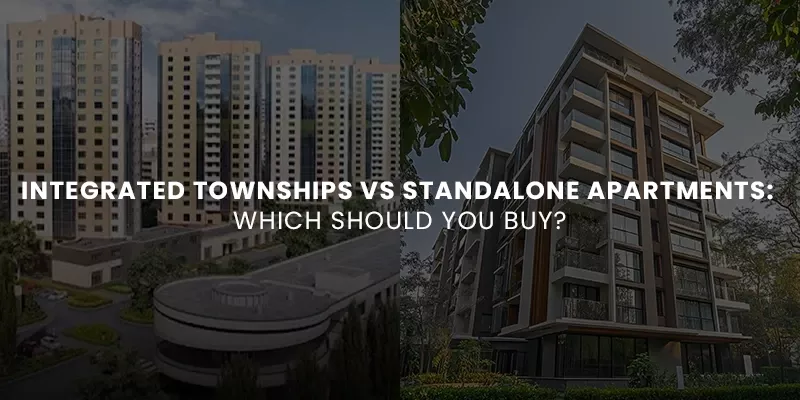
Integrated townships provide a complete, self-contained living ecosystem with extensive amenities, better infrastructure, and high appreciation potential. Standalone apartments, on the other hand, offer affordability, lower maintenance, and greater privacy, often located in more established areas. Both have their own pros and cons, and the right choice depends on your priorities, whether you value convenience and lifestyle or simplicity and cost-efficiency.
When buying a home today, most homebuyers compare integrated townships with standalone apartments to understand which offers better value, comfort, and lifestyle quality. Both options have their own strengths and limitations; your choice ultimately depends on your lifestyle, priorities, and long-term investment goals.
In this guide, we explain integrated township meaning, standalone apartment meaning, benefits, pros and cons, and help you decide which is right for you.
What Is an Integrated Township? (Integrated Township Meaning)
An integrated township is a large-scale, master-planned residential ecosystem that includes everything a resident might need: homes, schools, hospitals, shopping centres, offices, parks, entertainment zones, and other urban amenities, within a single, self-sufficient campus.
These townships typically follow a “live, work, play” model, reducing the need for daily commuting and offering a holistic lifestyle.
Benefits of Integrated Townships
Here are the major advantages:
- Self-Sustained Ecosystem: Townships offer all necessary facilities like supermarkets, clinics, gyms, co-working spaces, and recreation within walkable distances.
- Less Traffic & Better Infrastructure: They are well-planned with wider internal roads, greenery, and organized layouts that minimize congestion.
- Enhanced Security: Townships usually offer multi-layered security systems such as CCTV monitoring, access control, and security personnel.
- Lifestyle Amenities: Clubhouses, sports complexes, swimming pools, jogging tracks, community halls, and more, all within the gated environment.
5. Higher Appreciation Potential: Due to better planning and integrated facilities, property prices in large townships typically appreciate faster.
Standalone Apartment Meaning: What Is a Standalone Apartment?
A standalone apartment is a residential building constructed on a smaller plot, usually offering limited amenities and housing fewer families compared to large townships.
These buildings can range from 4–10 floors and are common in well-established neighborhoods with easy access to daily conveniences outside the property.
Pros of Standalone Apartments
Here’s why buyers choose standalone units:
- Lower maintenance costs
- More privacy due to fewer residents
- Often located in prime, central neighborhoods
- Quicker access to local shops, markets, schools, and public transport
- Faster possession timelines
Cons of Standalone Apartments
- Limited amenities
- Smaller open spaces
- Parking constraints
- Basic security compared to townships
- Lower resale demand than large gated communities
Integrated Townships vs Standalone Apartments: Key Differences
|
Feature |
Integrated Township |
Standalone Apartment |
|
Size |
Large-scale, multi-acre projects |
Smaller plot, single building |
|
Amenities |
Extensive (sports, clubs, retail, parks) |
Limited or basic |
|
Security |
Advanced, multi-layered |
Standard building-level |
|
Community Living |
Large, vibrant community |
Smaller, more private |
|
Maintenance Charges |
Higher |
Lower |
|
Appreciation Potential |
Generally high |
Moderate |
|
Convenience |
Everything within campus |
Dependent on locality |
Which One Should You Buy?
Your choice depends entirely on what you prioritize.
Choose an Integrated Township if you want:
- A holistic, resort-like lifestyle
- Many amenities for children & families
- Strong security
- Long-term value appreciation
- A self-sufficient community
Choose a Standalone Apartment if you want:
- Lower upfront cost
- Lower maintenance fees
- More privacy
- A home in a central or established neighborhood
- Limited need for amenities
Conclusion
Both integrated townships and standalone apartments offer unique advantages. Townships are ideal for families seeking convenience, lifestyle amenities, and long-term investment value. Standalone apartments suit buyers who prefer affordability, privacy, and central locations with access to everyday needs outside the community.
Evaluating your lifestyle, budget, and long-term goals will help you make a confident and well-informed decision.
Frequently Asked Questions
An integrated township is a large, self-sufficient residential development offering homes, amenities, commercial spaces, and essential services within one campus.
They offer lifestyle amenities, strong security, reduced commute, greenery, and higher property appreciation.
A standalone apartment is a single residential building with limited amenities, typically located in established city neighborhoods.
Generally, yes. They have lower maintenance charges and fewer amenities, making them more affordable.
Integrated townships often appreciate faster due to better planning and infrastructure, while standalone apartments offer steady demand in central locations.